
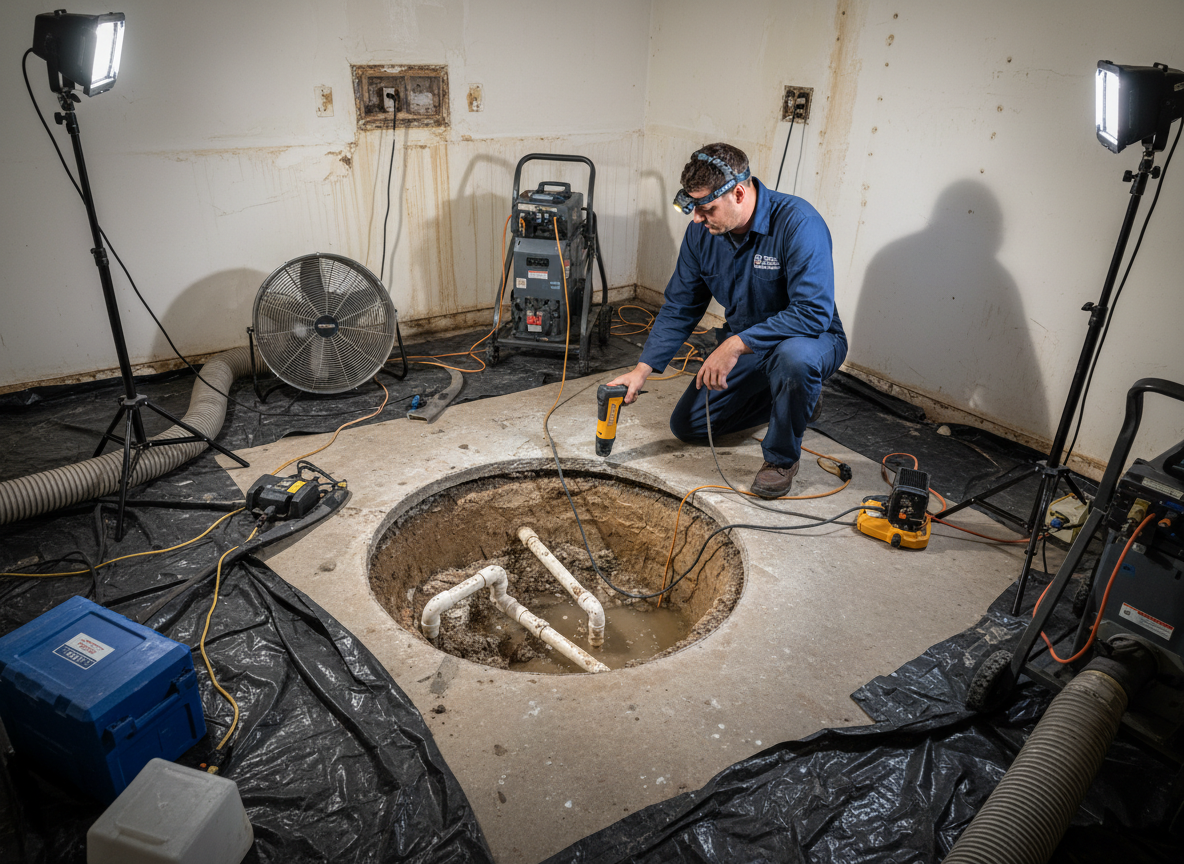
Gilbert homes built on concrete slabs in Maricopa County often see leaks from copper or PEX lines that expand and contract sharply during 110-degree summer days. Water migrates along the vapor barrier and re-enters living spaces at expansion joints or near garage slabs, creating hidden saturation that standard moisture meters miss until drywall shows damage weeks later. Technicians must remove baseboards, core drill test holes, and run negative-pressure drying to pull moisture from the 4- to 6-inch slab without cracking the surface.
Desert soil in neighborhoods such as San Tan Ranch and Layne Heights contains high clay content that swells when wet, shifting footings and stressing slab edges. This movement frequently re-opens repaired leaks unless the extraction team also installs perimeter French drains tied to the home’s existing grading. Mild winter temperatures allow year-round work, but rapid daytime heat requires dehumidifiers sized for 120-pint daily extraction to prevent secondary mold growth inside wall cavities.
Queen Creek and Chandler properties share the same aquifer-driven water chemistry that accelerates corrosion on older galvanized lines still present in some 1990s Agritopia builds. Restoration crews document every core sample and moisture reading for insurance adjusters while keeping the slab structurally intact to meet Maricopa County residential code requirements for load-bearing floors.
Technician insight
In Gilbert the thing that catches most people out with slab leak water damage restoration is how quickly clay-heavy soil around Layne Heights and Agritopia homes re-absorbs moisture after extraction, pushing it back into the slab edge during the next monsoon.
Hidden Slab Leak in Downtown Gilbert Residence
A homeowner noticed musty odors near the laundry room. Inspection revealed a pinhole leak under the 1998 slab that had saturated the vapor barrier and migrated toward the garage. Extraction and sub-slab drying were completed over four days, followed by joint sealing to prevent recurrence from seasonal expansion.
Slab Leak Water Damage Restoration Services We Offer
✓Slab Leak Detection and Mapping
Acoustic and thermal imaging locates active leaks under concrete without unnecessary demolition in Gilbert homes.
✓Concrete Slab Water Extraction
High-volume pumps and vacuum trucks remove standing water trapped between the slab and vapor barrier.
✓Sub-Slab Drying and Dehumidification
Injected air movers and commercial dehumidifiers pull residual moisture from the slab and sub-floor assembly.
✓Foundation Joint and Crack Sealing
Flexible polyurethane sealants restore expansion joints compromised by repeated wet-dry cycles in the desert.
✓Post-Leak Mold Containment
Negative-air containment and HEPA filtration address microbial growth that develops quickly after slab saturation.
Slab Leak Water Damage Restoration Cost in Gilbert, AZ
| Service | Typical Range | What Affects It |
|---|---|---|
| Initial Slab Assessment | $250–$450 | Includes acoustic and thermal scanning; higher for two-story homes |
| Water Extraction | $800–$1,800 | Varies with volume and whether garage or interior slab is involved |
| Drying and Monitoring | $600–$1,400 | Daily equipment rental plus moisture checks until dry |
| Joint Sealing and Minor Concrete Repair | $400–$900 | Depends on linear feet of joints and number of core holes |
Ranges are typical for Gilbert, AZ and confirmed with an exact written quote before any work starts.
How it works
- 1
Site Assessment
Technicians inspect the slab, map moisture migration, and document affected areas in neighborhoods such as Power Ranch.
- 2
Water Removal
Pumps and extraction mats pull free water from beneath the slab while protecting surrounding finishes.
- 3
Targeted Drying
Air movers and dehumidifiers run until slab moisture readings return to desert-climate baselines.
- 4
Restoration and Verification
Repairs are completed and final moisture logs are provided for insurance and homeowner records.
Pricing
Costs depend on slab access, leak duration, and square footage affected.